Plant Details
- Common Name: Fosteriana Tulip ‘Flaming Purissima’
- Hardiness Zones: 3-8
- Height: 16 inches
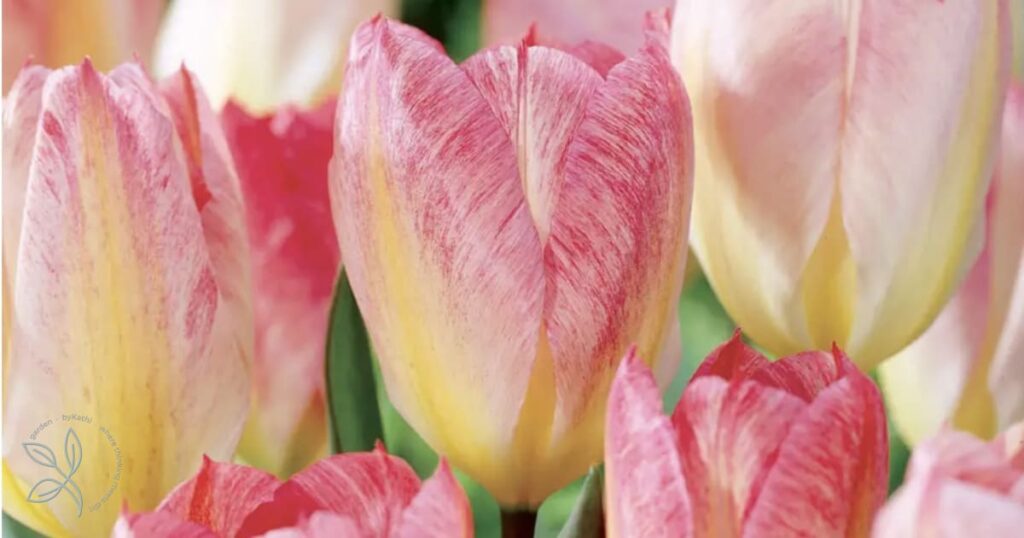
- Bloom: Cream with red flames in early spring (March)
- Light Requirements: Full Sun, Half Sun / Half Shade
- Soil Requirements: Well-drained, moderately rich
Opening Observation
I grew up in Washington’s Skagit Valley, where tulips weren’t a novelty; they were a season. Spring meant rows upon rows of color stretching to the horizon, fields so bright they looked painted against the gray. I never dug bulbs myself, though one of my best friends did. She was known for how quick she was, how cleanly she worked, and how much she could earn in a day. I think of her every time I plant tulips now, not in acres or rows but in small, scattered clusters across the garden. The work is slower and quieter, but the joy feels the same.
What It Is (The Basics)
Fosteriana Tulip ‘Flaming Purissima’ is an early-season tulip with soft cream petals marked by red flames that fade as the bloom matures. It grows on sturdy stems about sixteen inches tall and prefers full sun and well-drained soil. In theory, it is known for gentle color shifts as the flowers age, white to blush, blush to near pink, though I did not notice much of that this year. That could be timing or weather. The bulbs went in last fall, and the spring that followed was unusually wet and cold. They began to emerge just as we started a full front-yard renovation, and I ended up digging most of them back out before they ever had a chance to show off. I will know more next year when they have had time to settle and grow without interruption.
Where It Lives
Right now, my Flaming Purissima tulips live along the back edge of our yard, in a long bed that stretches behind the cedar panels we added this year. The panels create a soft frame; not a full fence, but enough structure to make the garden feel held. The bed faces somewhere between east and southeast, catching that kind of bright, angled light that shows up early and stays kind. It backs up to a strip of county land that feels more like a small forest, which keeps the space protected from wind but cool through spring. I can see the tulips from almost every window, the kitchen, the family room, and my husband’s office, which is exactly how I like it when the weather is still cold enough to keep me inside. They are planted in scattered clusters rather than tidy rows, small pockets of color where the light finds them. It is the same rhythm I have followed with all my tulips, a mix of early, mid, and late bloomers, layered through every bed so something is always waking up.
What I Have Learned
If there is one thing I have learned about tulips, it is that they do not care much for my timelines. I planted these last fall expecting an early show, the kind that brightens up gray mornings before anything else in the garden has the nerve to bloom. What I got instead was a lesson in timing, or rather, mistiming. The spring turned wet and cold, and by the time the first green tips started to show, we had already committed to redoing the front yard.
I dug them up before they had the chance to settle, careful to keep the soil around each bulb. They waited in bins until I could replant them along the back fence, which felt a little like pressing pause on a song mid note. I cannot tell you yet how they will perform, but I have immense trust in bulbs. They are constant. They are reliable. As long as they have not dried out and turned to dust, I can usually coax something out of them. I am excited to see what comes up this spring, even if it was a rush job getting them back into the ground after construction. I will share more when I know more.
Companionship Notes
Tulips are the punctuation marks in my garden, little bursts of attention where the eye might otherwise drift. I plant them near shrubs and perennials that take their time waking up, those deciduous plants that look bare in early spring or perennials like peonies and bleeding hearts that start from nothing each year. By the time the tulip foliage fades, those plants are rising, ready to take the spotlight.
I do not mix tulips with daffodils or hyacinths. They live in different parts of the yard so attention moves, one rhythm handing off to the next. The tulips keep their own tempo, early, mid, and late, spread across the beds in layers so that color travels through the garden instead of appearing all at once. When the foliage finally comes down, it is less an ending and more a reveal of what is next.
Maintenance Rhythm
I do not lift and store my tulips each year. I know how to, and I will move them if something feels out of place, but my preference is to let them naturalize. It is a kind of slow choreography I have learned to trust; they drift and settle, and the garden reshapes itself around them. When a bed starts to feel off balance, I dig a few and reposition them, but mostly I let them tell me where they want to be.
Tulips are dependable for me. They come back strong most years, and if they do not, I take it as permission to try something new. There is always a variety that catches my eye, a parrot, a double peony, something bright and unruly, but I always find my way back to the classics. The only real nuisance here is the rabbits. For whatever reason, they leave the daffodils and hyacinths alone but cannot resist tulip leaves. It never seems to hurt the bulbs, but it does leave the foliage looking rough. I have learned to accept it as part of the spring landscape.
The Verdict (So Far)
I cannot say much yet about Flaming Purissima’s long-term performance, but I have every reason to be optimistic. The bulbs looked healthy when I moved them, and they have settled into their new space as if they belonged there all along. I trust bulbs; they are steady. They hold on through upheaval and surprise you when the season turns in their favor.
I am curious to see what color we get next spring, whether the red flames will show more clearly now that they are in full light. For now, it is enough to know they are resting in good soil, waiting. That is what I love most about tulips, their willingness to begin again, quietly, on their own time.
Affiliate Disclosure: Some of the links in my posts are affiliate links. That means if you choose to click or buy, I may earn a small commission at no extra cost to you. It helps support this site and the ongoing work of growing, testing, and sharing what I learn here.