
A neighbor posted in a local mom’s group asking for help with landscape planning. She was hoping to surprise her parents with a refreshed front yard while they were away. She would do the planting herself, she just needed someone to tell her what to plant, how to lay it out, and how to make it feel intentional. I said yes, and what followed was a full front yard plan across four beds.
This was the one along the garage. It would become a shade garden design by necessity. And it came with a constraint that shaped everything.
She Wanted Big Flowers
The reference photos she sent were gorgeous. Full sun beds overflowing with bloom, the kind of cottage garden abundance that looks effortless in photographs and takes considerable effort in practice. Big color, big texture, the works. She also mentioned that fragrance would be welcome here, especially along a path people use every day.
The bed got no direct sun.
It runs along the north side of a garage that juts out from the house in an L shape, a narrow 23-foot strip that borders the main walkway to the front door. The white garage wall brightens the space, but it also demands contrast. Anything too soft disappears against it. And the light, which never gets stronger than indirect, rules out most of what was in those reference photos.
This is the constraint that shapes the whole design. And once I stopped trying to work around it, it became a gift.
What Shade Actually Offers
Full shade does not mean no beauty. It means a different vocabulary. Instead of chasing color through blooms alone, you start layering texture, foliage, and timing. You think about what the bed looks like in May, in July, in October, and in winter when the walkway still gets used every day.
She was open to starting fresh and willing to do the work. She just needed a plan she could take to the nursery and execute without me there. That clarity of brief is its own kind of gift to a designer. No attachment to what was there, no emotional negotiation. Just: what should be here, and why.
The Plan: Five Zones
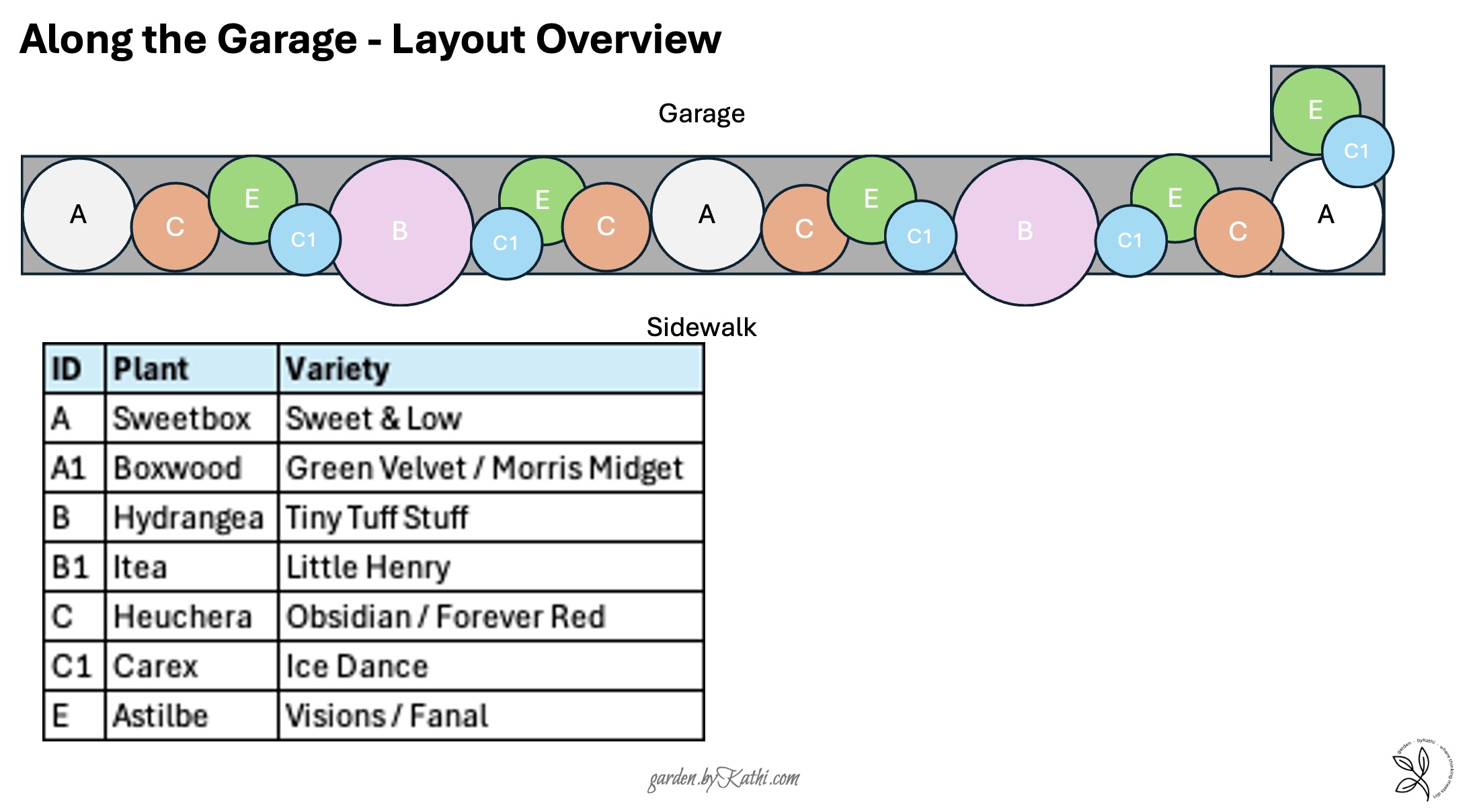
For a bed this narrow, structure matters more than variety. The eye needs repetition and rhythm to read a two-foot-wide strip as intentional rather than random. The layout divided into five zones, each doing a specific job.
A — Evergreen Anchors
Sweetbox (Sarcococca ‘Sweet and Low’) at the walkway end. She asked for fragrance, and this is the answer for shade: tiny white flowers in late winter, a subtle sweetness that meets you before you reach the door, and glossy evergreen foliage that holds its presence the rest of the year. Compact boxwood works as an alternate for a cleaner, more formal look, though you lose the fragrance.
B — Flowering Anchors
Hydrangea ‘Tiny Tuff Stuff’ for the blooms she wanted. Compact, reblooming, and the lacecap flowers have a delicacy that suits the space better than a big mophead. She wanted flowers, and this delivers them without overwhelming a two-foot bed. The alternate is Itea ‘Little Henry,’ a native sweetspire with bottlebrush blooms and some of the most beautiful red fall color you will find on a compact shrub.
C — Foliage Color
Heuchera in deep purples and rich reds. This is the zone that carries the design between bloom cycles. Against the white garage wall, dark heuchera foliage reads as bold and intentional, and it provides the texture contrast that keeps the bed from looking flat.
D — Texture and Bloom
Astilbe for vertical softness. The feathery plumes add height and movement, and they do something important against a bright wall: they create shadow. A bed without shadow on a white surface looks washed out. Astilbe fixes that.
E — Optional Edge
Carex ‘Ice Dance’ along the front edge. Fine-textured, semi-evergreen, low enough to blur the line between bed and walkway without spilling over. An edge you do not have to maintain is always the right edge.
What Made This Work
Every plant on this list passed the same quiet checklist: fits the width without crowding, tolerates full shade without constant attention, offers something beyond a short bloom window, holds together as part of a whole.
That last requirement is the one that gets skipped most often. Heuchera and astilbe work together because their textures are opposites, the broad bold leaf against the feathery plume. Sweetbox and carex work together because their scales are different, the small glossy leaf against the fine grass blade. The whole bed reads as intentional because every combination has a reason.
She took the plan to the nursery. The staff member who helped her was astonished at how thorough it was. She planted it herself. That is exactly how this was supposed to go.
This plan was part of a complete multi-bed design package — bubble diagrams, plant photos, a full detail table, and a shopping list. Download it free here.
Affiliate Disclosure: Some of the links in my posts are affiliate links. That means if you choose to click or buy, I may earn a small commission at no extra cost to you. These links help support the ongoing work of growing, testing, and sharing that I do in this space.