This was part of a larger project, a neighbor who had posted in a local mom’s group hoping to surprise her parents with a refreshed front yard. Four beds, a full plan, the whole thing designed as a gift. If you want to read how it started, that story begins with the hostas in Two Roses and a Thorny Decision.
The front window bed was the blank slate garden design problem of the group — the one that had the most to work with and the least to show for it. Sixteen feet wide, seven or eight feet deep, with curved popouts at both corners. And full of plants that had no business being next to each other.
How It Got This Way
The daughter described it simply: anytime anyone gave her mother a plant, it went into that bed. A division from a neighbor’s garden. Something in a pot from a birthday. A cutting someone thought she might like. It did not matter whether it suited the space or went with what was already there. She just wanted to keep it alive. Into the bed it went.
And here is the thing: they all grew. Every one of them. She clearly had a way with plants, an instinct for keeping things alive that most gardeners would envy. What she did not have, and did not need in the moment of accepting each gift, was any thought about height or texture or placement. The result was a collection of perfectly healthy plants making no sense together, each one asserting itself without any relationship to what was next to it.
That is not a blank slate. That is a love language expressed in plants, accumulated over years, with no design underneath it at all.
What Was Actually There
Two boxwoods had been there long enough to look like they belonged, and they did. Compact, rounded, evergreen, they gave the bed year-round presence and a consistent anchor at each inner corner regardless of the season. They were staying.
Everything else was up for reconsideration.
The Design
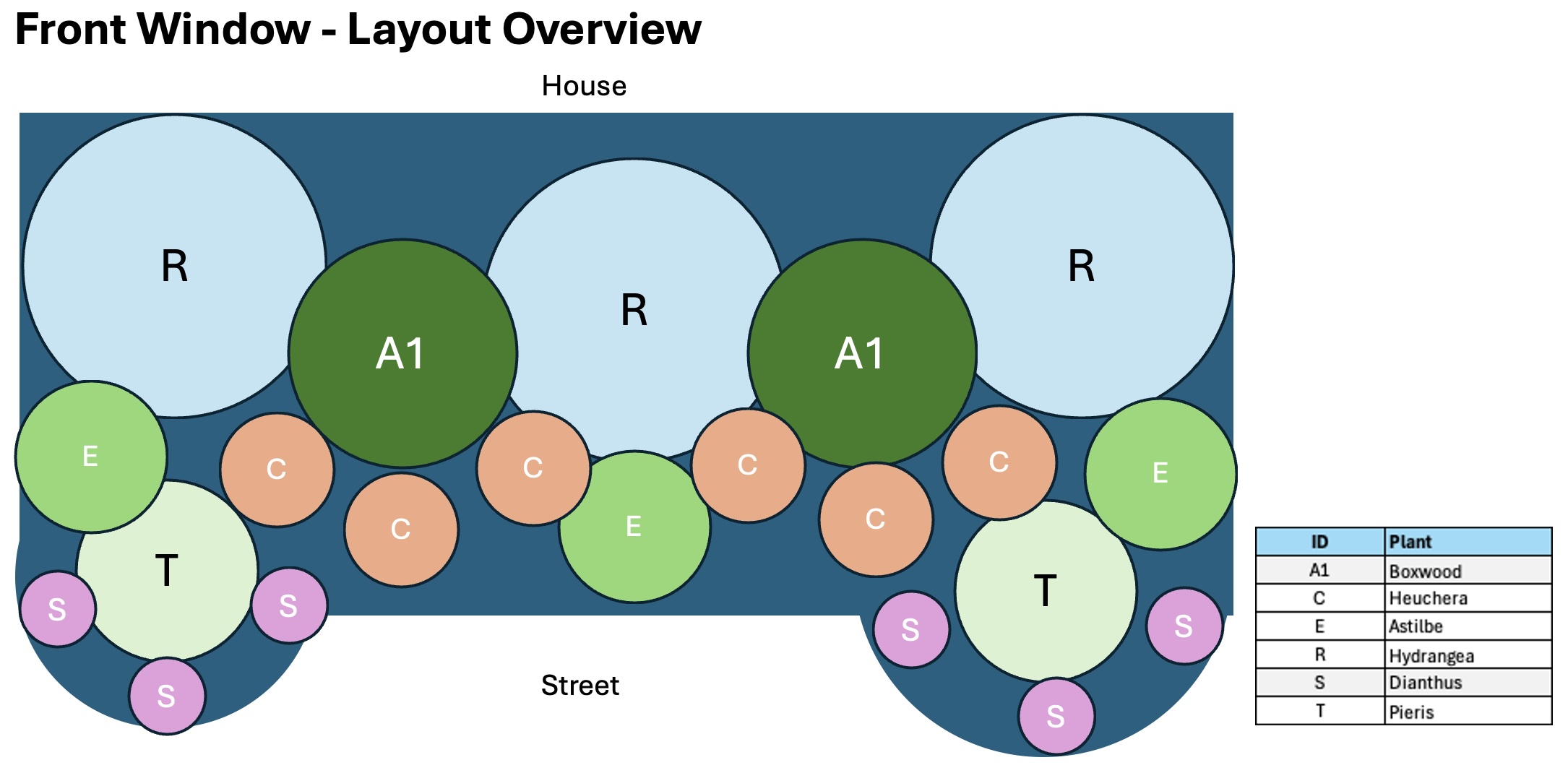
The bed called for layers: height at the back, color and texture in the middle, softness at the edges. With the boxwoods already holding the inner corners, the design had its starting point.
The back layer went to hydrangea. Let’s Dance Lovable, a reblooming bigleaf hydrangea with mophead blooms that shift between pink and blue depending on soil pH. She wanted flowers, and this was the right answer for a bed that gets enough sun to bloom well. Three of them across the back, giving the bed its season-long focal point and the abundance she was after.
The middle layer went to Heuchera in Georgia Plum, a deep plum-rose tone with a silver overlay that catches light differently through the season. Six plants creating a consistent band of color and texture in front of the hydrangeas. The color choice was deliberate: a deep plum works with the hydrangeas whether they bloom pink or blue, so the bed holds together regardless of what the soil decides to do that year.
Astilbe in Vision in Pink filled the spaces between, feathery vertical texture and soft pink plumes in early summer. It also did something useful for the project as a whole: the same Astilbe appeared in the garage bed design. That repetition was intentional, a thread connecting two beds on different sides of the yard, giving the front of the property a sense of continuity even though the plantings are otherwise quite different.
The curved corner popouts got Pieris ‘Little Heath’, a dwarf evergreen with fine variegated foliage and drooping white flower clusters in spring. Compact, structural, interesting year-round without demanding attention. The popouts had been wasted space; Pieris turned them into deliberate punctuation.
Dianthus edged the front in three varieties chosen for their compact mounding habit and soft pink blooms: Hush Pink, Mountain Frost Pink Twinkle, and Pretty Poppers Appleblossom. Spring through fall bloom, small enough to stay in their lane, soft enough to give the front edge the kind of welcoming finish that makes a bed look cared for from the street.
What the Design Had to Do
Every plant on this list had to cooperate with its neighbors. That requirement matters especially in a bed with a history of accumulation. The previous approach had been individual plants making individual claims on space. The new design needed plants that understood they were part of something larger.
Heuchera and astilbe do that naturally. So does Dianthus at the edges. The hydrangeas are the showoffs, which is exactly what the back layer needs to be. The Pieris holds the corners quietly. The boxwoods anchor the whole thing in every season.
The bed that had been a collection became a composition.
On the Gift Plants
Her mother’s habit of accepting every plant anyone offered and finding it a home is not a design problem. It is generous and optimistic and deeply human. What changes with a design in place is that there is now a framework, somewhere a new gift might actually fit, something it might complement, a way it could be absorbed without disrupting what is already working.
A plant addiction is only a design problem when there is no design. With one in place, it becomes a running conversation between the gardener and the garden.
Which, honestly, is what most gardens are.
Want to see what a complete planting plan looks like? The full four-bed design package is a free download — bubble diagrams, plant photos, a detail table, and a shopping list. Download it here.
Affiliate Disclosure: Some of the links in my posts are affiliate links. That means if you choose to click or buy, I may earn a small commission at no extra cost to you. These links help support the ongoing work of growing, testing, and sharing that I do in this space.