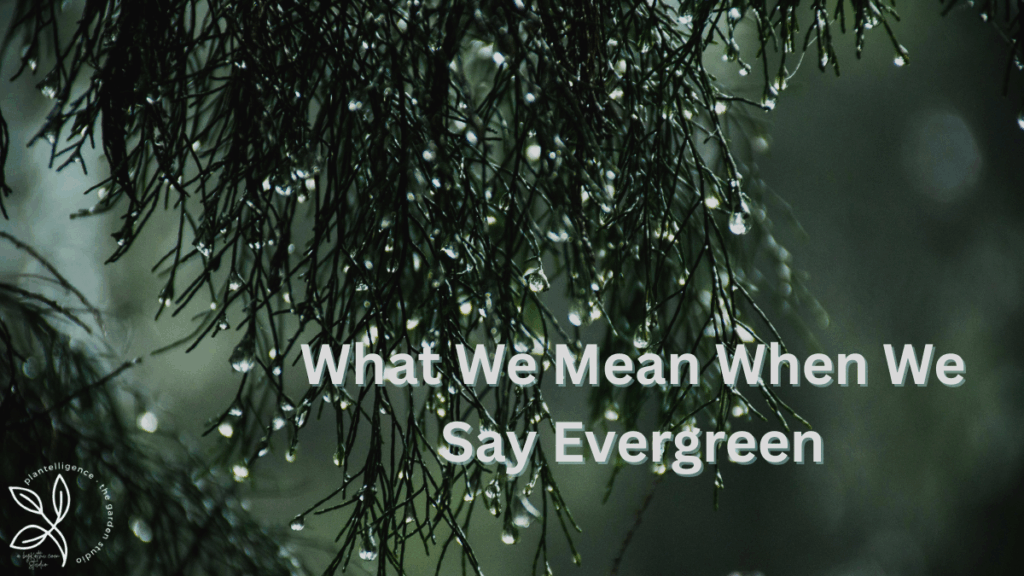
On cold mornings, I step outside with coffee and look across the beds. The air is still, the soil frozen, and the evergreens are the only things that seem to exhale. Their color shifts in this light, less green than olive or slate, a palette that makes sense only against the gray sky. They do not demand attention; they hold it quietly. In July, I barely notice them. The garden is loud then, all bloom and motion. But by December, when the perennials collapse and the trees go bare, the evergreens step forward without moving an inch. They simply allow themselves to be seen.
The Symbol of Permanence
The tradition of bringing greenery indoors in winter has existed for centuries, long before we called it a holiday. The idea endures because it speaks to something ancient in us, the need to see life persist when everything else has gone dormant.
Out in the yard, permanence looks different. True evergreens are quiet and humble. They do not dazzle; they endure. They stand through wind and snow, keeping their form through freeze and thaw. When I look at them in the low light of January, I remember that constancy does not need to announce itself. It only needs to keep showing up.
In the garden, that kind of steadiness is not stillness. It is the quiet work of holding shape when everything else shifts. Each season brings new light, new color, new sound. The evergreens adjust to it all without complaint. Their permanence lies not in resisting change, but in accommodating it with grace.
The Real Work of Evergreens
In my garden, evergreens are not background actors. They are the ones that hold the stage when the rest of the cast takes a breath. A pieris softens the edge of the porch where the foundation dips, and when it blooms, it glows. A boxwood anchors the walkway, quiet through most of the year but indispensable when color fades.
Every plant has its turn. I do not want the bleeding hearts and the peonies competing for the same attention. They belong to different acts of the same performance. The garden, when planned well, is a kind of choreography, each plant stepping into the light when the moment comes, then gracefully stepping back. The evergreens do not bow out. They remain, steadying the whole composition so the others can shine.
That, to me, is the real meaning of evergreen. It is not about standing still. It is about staying steady. Their branches bronze in cold wind, their needles shift in tone, but they remain. They hold their place, adapting and persisting. If deciduous plants are the conversation, evergreens are the silence that allows the words to settle.
Change Within Constancy
Not every evergreen stays perfectly green. Some cryptomerias blush bronze in winter, and a few junipers turn smoky blue. I used to worry about that, thinking something was wrong. Now I see it differently. Those shifts are proof that the garden is never empty, even when it looks still. It changes hue, but not presence.
Constancy is not sameness. What lasts is form, not uniformity. The evergreen’s color may deepen or dull, but its presence carries weight. It keeps the garden legible through transition, the way steady friends keep our lives from unraveling when everything else moves.
They also teach patience. You cannot hurry an evergreen. Even the fast-growing ones take years to show their true shape. The boxwood I planted when we moved in was barely a foot tall. Now it is waist-high and still rounding into itself. I will probably never see it fully mature, and that feels right somehow. Planting evergreens is an act of trust in time itself, an investment in slow growth and a willingness to imagine years beyond your own attention span.
What They Reveal
Evergreens do more than hold their own shape; they reveal the shape of everything around them. When the leaves drop from the trees and the perennials retreat, the structure of the garden becomes visible. The empty space matters as much as the filled one.
Against a backdrop of boxwood or pieris, a single branch of redtwig dogwood looks deliberate. The bare arms of a Japanese maple seem sculptural. Spring bulbs look brighter when they emerge near something that never left. The evergreens remind me that beauty often lives in contrast. Their constancy allows other things to change in full view.
They also remind me of control and wildness, how the two coexist in tension. We clip boxwoods into spheres and line hedges like borders, but these are ancient, primal plants. They predate flowering species by millions of years. They allow us to impose our geometry, but the wildness remains under the surface. Every neatly trimmed edge is an agreement between discipline and instinct, a living balance between what we shape and what shapes us.
When Permanence Fails
Not all of them make it. I have lost evergreens to winter burn, to root rot, and to poor placement. Each loss feels different from losing a perennial. Those are meant to come and go. But when a pieris browns from the inside out, or a boxwood simply stops thriving, it feels like a broken promise. The thing that was supposed to stay, didn’t.
And yet, that loss teaches something too. Constancy is not guaranteed; it is earned, season by season, year by year. The evergreens that endure have survived more than weather. They have endured our mistakes, our neglect, and our learning. The ones that remain are the ones that have adapted. They hold the story of persistence not as a concept but as evidence.
There is a kind of humility in that, a recognition that permanence is not our achievement but our privilege to witness.
Holding Form
Choosing evergreens is a quiet kind of decision. It is a way of preparing for the season when attention turns elsewhere. A good evergreen asks little and gives much: rhythm, structure, calm. These are the plants that give the garden its bones.
There is something almost radical about planting for reliability in a culture that celebrates novelty. Garden centers overflow each spring with the next big thing, new cultivars, unusual colors, fleeting trends. But evergreens ask a harder question: what do you still want to see in ten years? What do you want to look at in February when nothing else is giving you anything?
Those are sobering questions, but generous ones too. Planting evergreens is planting for the future version of yourself, the one who will be tired or distracted or busy but still want beauty to hold its shape. The evergreen does not ask for much. It just needs to be placed well and left to do what it was built to do. That, to me, is care in form.
The Return to Season
When the holidays end, most of us feel the pull toward restoration. The cut tree by the curb will be chipped for mulch, returning to the soil it came from. The wreath fades back to the compost pile. During the holiday season, I like to keep a small living evergreen indoors for its scent, its color, and the quiet reminder that life persists even in the coldest months.
Outside, the evergreens in the yard hold their places too, constant through frost and fog. Not because they perform permanence, but because they are permanence, or the closest we ever get to it in a garden.
Maybe that is the truest meaning of evergreen. It is not the spectacle that signals a season, but the patience that carries it. The garden teaches many lessons, but this might be the hardest one: that the most essential things are often the quietest. Constancy does not need to dazzle. It only needs to remain.
When I walk past the boxwoods in January, their green turned slightly olive against the gray, I do not wish them brighter. The landscape is muted, and that is brightness enough.
If this reflection stirs the gardener in you, you might enjoy its companion piece, Evergreens That Work for You, a practical look at choosing evergreens that soften, settle, and serve the spaces you live with every day.
Affiliate Disclosure: Some of the links in my posts are affiliate links. That means if you choose to click or buy, I may earn a small commission at no extra cost to you. It helps support this site and the ongoing work of growing, testing, and sharing what I learn here.